Abundant supply drives innovation in agricultural products
2025-10-28 09:05:42 來源:人民網 
2025-10-28 09:05:42 來源:人民網
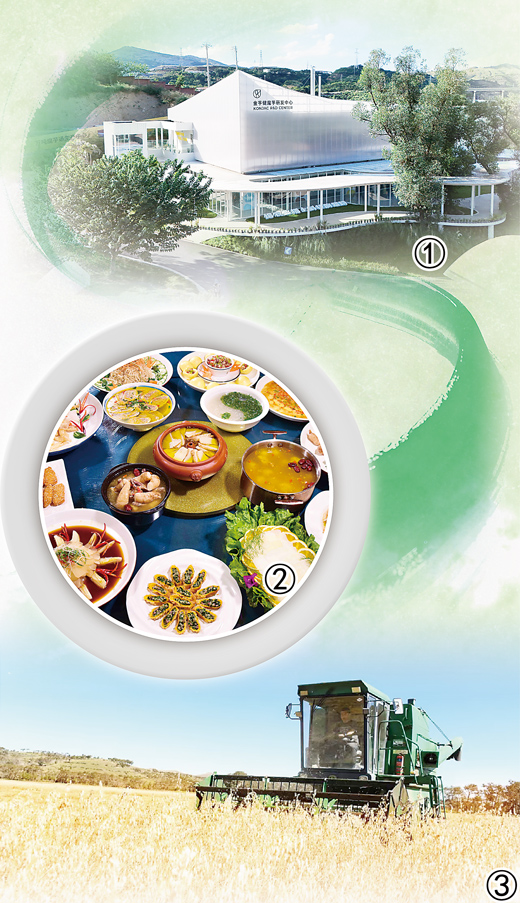
1. Photo shows a konjac industry demonstration park in Yanbian county, southwest China's Sichuan Province. (Photo/Wang Mingyu)
2. Dishes made with Gastrodia elata are served at a restaurant in Yiliang county, southwest China's Yunnan Province. (Photo/Zhao Yu)
3. A farmer harvests oats at a farm in Zhuozi county, Ulanqab city, north China's Inner Mongolia Autonomous Region. (Photo/Zhang Kexin)
Since the start of the 14th Five-Year Plan (2021–2025), China has certified 36,000 agricultural products as green, organic, famous, characteristic, high-quality, advanced or carrying geographical indications. The total annual output of green and high-quality agricultural products supplied to society exceeds 200 million tonnes.
In recent years, the growing variety of agricultural products has given rise to new niche sectors across the industry.
Riding the wave of a health-conscious trend, once-overlooked coarse grains and legumes are quietly returning to dining tables as new staples.
In the workshop of Yinshan Youmai Food Co., Ltd. in north China's Inner Mongolia Autonomous Region, workers are busy dehulling, sorting and cutting oat grains. A newly developed low-glycemic-index (GI) oat product is ready for shipment across the country. The company is based in Ulanqab, at the northern foot of the Yinshan Mountains, a prime area for growing high-quality naked oats.
"In recent years, we've developed more than 70 products catering to different needs, including staple foods, low-GI options and instant mixes," said Ji Fushan, head of the company. Leveraging growing demand for whole-grain and healthy diets, the company's oat products are now sold in more than 200 Chinese cities and exported to North America, Southeast Asia, Japan and South Korea. Sales have exceeded 300 million yuan ($42 million), helping raise the incomes of more than 10,000 farming and herding households.
Under the framework of the all-encompassing approach to food, China's food supply system is continuously improving to meet changing consumer demands. Dietary management focused on fat reduction, blood sugar control, anti-aging and better sleep has become a new driver of growth in agricultural production and sales.
In November 2023, Gastrodia elata was officially included in the catalog of substances considered both medicine and food. As one of the country's six main Gastrodia elata production regions, Zhaotong city in southwest China's Yunnan Province has, in recent years, stepped up the processing and utilization of local Gastrodia elata.
The city now boasts 100,000 mu (6,667 hectares) of organically certified Gastrodia elata, generating a total output value of more than 9.39 billion yuan.
"We've built the nation's largest international Gastrodia elata trading center and developed more than 30 processed products," said Pi Wanyuan, director of the Gastrodia Elata Industry Center in Yiliang county, Zhaotong.
In February 2025, the Ministry of Agriculture and Rural Affairs, the National Health Commission, and the Ministry of Industry and Information Technology jointly released the China Food and Nutrition Development Outline (2025–2030), which for the first time proposed nutrition-oriented agricultural production.
"Nutrition-focused agriculture is a major direction for the future," said Zhu Dazhou, deputy director at the Science and Technology Department of the Institute of Food and Nutrition Development under the Ministry of Agriculture and Rural Affairs.
He noted that functional foods are becoming more diverse, precise and convenient. Traditional forms such as capsules, tablets and oral liquids are increasingly being incorporated into everyday foods. Nutritionally enhanced products, including selenium-rich rice, DHA-fortified eggs and high-oleic peanuts, are also winning greater consumer attention.
At 7 a.m., duck feet are processed at a production line of Quanrun Food Co., Ltd., located in Xinji town, Yinan county, east China's Shandong Province.
"We have established long-term partnerships with several large local slaughterhouses, from which we source fresh duck feet, chicken feet, duck necks and duck gizzards each year. Our packaged snack products are very popular in the market," said Lin Qingyu, general manager of the company.
Last year, the company processed over 5,000 tonnes of various livestock and poultry products, generating more than 140 million yuan in industrial output value.
By the end of 2023, China's processing rate for major agricultural products had reached 73 percent, up 4.5 percentage points from 2019.
Deep processing of agricultural products not only makes them more convenient to consume but also meets the needs of today's fast-paced lifestyles, said Wang Fengzhong, director of the innovation team at the Institute of Food and Nutrition Development under the Ministry of Agriculture and Rural Affairs.
Nationwide, more than 80 percent of agricultural processing companies and cooperatives have established benefit-sharing mechanisms with smallholders. These partnerships have helped 125 million farming households increase their incomes, on average, by more than 30 percent compared with those not involved.
To address gaps in processing capacity, China has strengthened technical support and cultivated leading industry players. Since 2018, 42 ministerial-level key laboratories and 43 ministerial-level experimental research bases have been established for agricultural product processing, and more than 200 processing standards have been developed.
Konjac-based snacks, such as konjac strips, konjac liangpi (a noodle dish) and konjac jelly, are rapidly gaining popularity in China's snack market. According to a 2024 white paper on China's leisure snack industry, online sales of konjac snacks rose 128 percent year on year, while offline channels also recorded growth of more than 60 percent.
Southwest China's Sichuan Province is one of the country's main konjac-producing regions. In Yanbian county, Panzhihua city, konjac has become a specialty industry generating nearly 200 million yuan in output value.
In Luochuan county, northwest China's Shaanxi Province, apples are processed into vinegar, wine, and crispy snacks. The county has developed five premium apple sightseeing routes and 46 visitor orchards, extending the fruit's economic value.
In Anji county, east China's Zhejiang Province, bamboo has become a key driver of tourism and local economic growth. Bamboo is featured in a range of experiences, including hotels, B&Bs, campsites, cafes and adventure routes. The county attracts more than 5 million tourist visits annually, generating over 1.5 billion yuan in revenue.
編輯: 馬路遙
 以上文章僅代表作者個人觀點,本網只是轉載,如涉及作品內容、版權、稿酬問題,請及時聯系我們。電話:029-63903870
 “無人植物工廠”,勾勒未來農
 寶雞展團農高會秀特色,鳳翔豆
 西安公安交管1900余名警力守
 賽格電腦商城10月17日正式停
 神木:深耕質量沃土 篤行奮進
 鳳翔區農業發展與特色產業的
 “走讀絲路·行閱中亞”2025跨國圖書出版交
 寶雞隴縣49件國寶級文物驚艷亮相澳大利亞
  西鳳酒亮相2025韓國葡萄酒與烈酒博覽會
 High-tech exhibits displayed at 9th Chin