Industrial heritage sites fuel China's tourism
2025-11-04 09:43:47 來源:人民網 
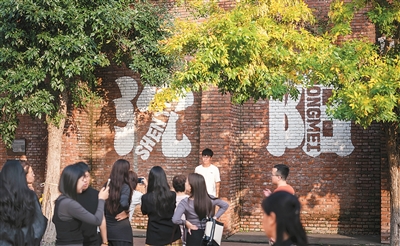
Photo shows visitors at the former Hongmei MSG Factory in Tiexi district, Shenyang, northeast China's Liaoning Province. (Xinhua/Pan Yulong)
By deeply exploring the cultural essence embedded in industrial heritage and developing diverse tourism scenarios and forms, an increasing number of former industrial sites in China have been turned into tourist destinations.
The Ministry of Industry and Information Technology recently unveiled its seventh batch of national industrial heritage sites, recognizing 32 locations across the country.
China is the only country with all industrial categories under the United Nations' industrial classification, making its comprehensive industrial system a treasure trove for the development of industrial tourism. Its diverse array of industrial heritage sites offers visitors tangible connections to the nation's industrial culture.
In Tiexi district, Shenyang, northeast China's Liaoning Province, the former Hongmei MSG Factory sprawls across more than 60,000 square meters. Though production ceased years ago, the site remains vibrant. Thirteen surviving factory buildings have been transformed into a cultural and creative park housing art exhibitions, office spaces, and cultural and creative businesses. The central plaza now hosts over 80 specialty shops, drawing local residents seeking leisure experiences.
The renovation carefully preserved the historic buildings' original character while incorporating contemporary artistic elements. Today, the complex is home to more than 30 cultural organizations spanning literature, music, fine arts and calligraphy, hosting nearly 200 performances and exhibitions annually. What was once a cacophony of industrial machinery has evolved into a fashionable lifestyle destination.
The site was also designated as one of China's first national-level night culture and tourism consumption clusters.
According to an official from Tiexi district's culture and tourism bureau, the cultural and creative park currently provides over 1,000 jobs and generates nearly 120 million yuan ($16.9 million) in annual output, becoming a highlight of industrial tourism development in Shenyang, an old industrial city.
Chang'an Dahua Textile Factory, established in 1935 in Xi'an, northwest China's Shaanxi Province, fell silent as urban development progressed. The factory has since been converted into the Xi'an Dahua Museum, where memories of its industrial heyday are preserved.
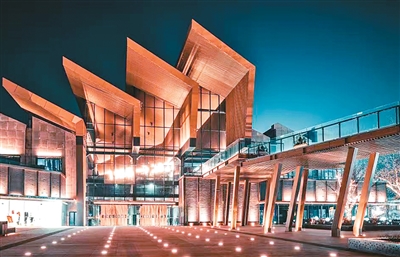
Photo shows a night view of the former Dahua Textile Factory in Xi'an, northwest China's Shaanxi Province. (Photo courtesy of the Xi'an Municipal Bureau of Culture and Tourism)
During the factory-to-museum transformation, the rust-stained steel trusses and grooves in the workshop floors left by machinery were retained to maintain the site's original appearance and preserve memories for retired workers and local residents.
The museum and surrounding streets have been reimagined as an industrial culture park, where industrial aesthetics blend with the everyday vitality of neighborhood shops to create a distinctive charm.
In Sandongqiao village, Dingshu town, Yixing, east China's Jiangsu Province, the ancient ritual of firing the Qianshu Dragon Kiln, which has a history of over 600 years, continues during traditional festivals and special occasions, a testament to enduring craftsmanship despite modern alternatives. Dating back to the Ming Dynasty (1368-1644), this kiln holds a unique status as the only one in Jiangsu that still fires ceramics using traditional wood-burning methods.
To balance preservation with development, Dingshu town organizes six to eight firings annually, drawing visitors to witness the kiln opening in person, while millions more watch online via livestreams.

Photo shows the Qianshu Dragon Kiln in Sandongqiao village, Dingshu town, Yixing, east China's Jiangsu Province. (Photo courtesy of the Dingshu town government)
Following protective restoration work in recent years, an exhibition hall for ceramic products now sits across from the Qianshu Dragon Kiln. Sandongqiao village organizes exchange activities, has established pottery workshops and industry associations, and nurtures young artisans. Some skilled villagers have opened home-based studios where they guide visitors through kiln tours, pottery classes and ceramic culture experiences.
The Qianshu Dragon Kiln has become the village's signature attraction. The village's pottery production and agricultural-cultural-tourism industries generate over 200 million yuan annually, with per capita income reaching 46,000 yuan and collective village revenue hitting 6.5 million yuan.
編輯: 馬路遙
 以上文章僅代表作者個人觀點,本網只是轉載,如涉及作品內容、版權、稿酬問題,請及時聯系我們。電話:029-63903870
 2025寶雞馬拉松鳴槍開賽
 “無人植物工廠”,勾勒未來農
 寶雞展團農高會秀特色,鳳翔豆
 西安公安交管1900余名警力守
 賽格電腦商城10月17日正式停
 神木:深耕質量沃土 篤行奮進
 “走讀絲路·行閱中亞”2025跨國圖書出版交
 寶雞隴縣49件國寶級文物驚艷亮相澳大利亞
  西鳳酒亮相2025韓國葡萄酒與烈酒博覽會
 High-tech exhibits displayed at 9th Chin